
Share:
A blog for Catholic men that seeks to encourage virtue, the pursuit of holiness and the art of true masculinity.
10 Ways Jesus Fulfilled the 1000-Year-Old Prophecy
April 2, 2026
By Devin Schadt
Did Jesus Despair? “My God Why Have You Abandoned Me?”
What This Article Is About
This article explains how Christ’s cry of abandonment on the Cross is not defeat.
Rather, it is the proclamation of His identity and the fulfillment of Psalm 22, revealing His ultimate victory over sin and death.
What You Will Find in This Article
- The true meaning of Christ’s cry, “My God, My God, why have you abandoned me?”
- How Jesus intentionally embraced the experience of abandonment
- The connection between the Crucifixion and Psalm 22
- Ten specific ways Jesus fulfilled this Messianic prophecy
- The prophetic promise of Christ’s ultimate triumph and resurrection
Did Jesus Despair? “My God Why Have You Abandoned Me?”
The Cry of Abandonment: Defeat or Divine Purpose?
What did Jesus mean, “My God, My God, why have you abandoned me?”
Could our Lord, by means of this haunting cry, be admitting defeat?
Furthermore, Our Lord appears to be saying that He believes that God His Father has left Him.
Christ Embraces the Experience of the Sinner
However, Jesus, to be a perfect sacrificial offering to God, was intent on identifying Himself as sin, though He had sinned not.
Our Lord willed to embrace the experience of abandonment that the sinner experiences when separated from God.
Indeed, Jesus deemed it necessary to endure the abandonment caused by sin for the purpose of fully redeeming all sinners.
As Jesus pressed on with the intention to complete His perfect sacrifice and human oblation, the evil one launched his final attack against Jesus’ identity.
Hence the devil taunted the Savior, tempting Him to prove Himself by delivering Himself from the Cross.
Essentially, the temptation consisted of attempting to convince Jesus to use His supernatural powers to deliver Himself from His execution.
Thus, if Jesus refuses to succumb to the temptation, His ministry would end in utter failure, none would continue to believe in Him, and all would be lost.
Yet, Christ, rather than using supernatural prerogatives, responds to the tempters’ attack in a manner that has echoed throughout the ages.
This prophetic cry proved to those present at the Crucifixion and to those who commemorate it, that Jesus is the human incarnation of God.
Indeed, Jesus’ cry of abandonment testifies that He is divine, and that He is the king who is sovereign over all creation.
Psalm 22: The Key to Understanding the Cross
From His seat of authority, Christ cried out, “O God my God. . . why hast thou forsaken me” (Ps 22:1).
To the modern ear, this is the expression of absolute defeat.
In Jesus’ day, however, the utterance of the first sentence of a psalm summons those praying to remember and recite the psalm in its entirety.
The first line is like a gunshot that begins the race of recalling the psalm.
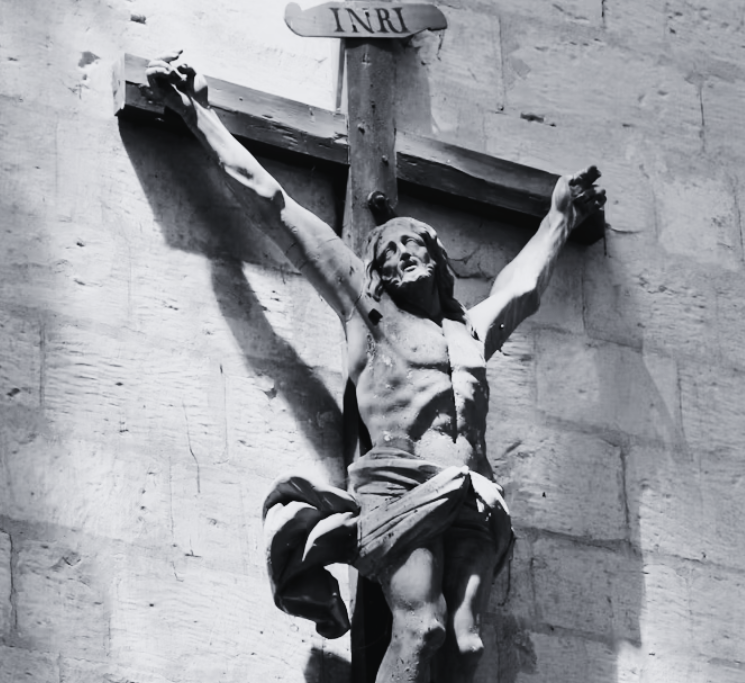
Far from a cry of defeat, the words, “O God my God . . . why hast thou forsaken me” was Jesus’ recitation of the first line of the prophetic Messianic Psalm 22.
By saying the first line of Psalm 22, Jesus was stating that the one-thousand-year-old prophecy contained in the psalm is now fulfilled in Him.
Far from being a cry of death, at that very moment, from the Cross, in the face of His nemesis, Christ proclaimed His definitive victory over evil.
10 Ways Jesus Fulfilled the 1000-Year-Old Prophecy
- The psalms states, “I am a worm, and no man” (Ps 22:6).
Christ connects Himself with the figure of the worm, particularly the worm or serpent that Moses fashioned from bronze and fastened to the staff that all who looked upon would be healed.
Indeed, all who look upon the Son of Man will be saved (see Jn 6:40).
- The psalm continues: “All they that saw me have laughed me to scorn: they have spoken with the lips, and wagged the head (Ps 22:7, emphasis added).
This is fulfilled in Christ, when “they that passed by blasphemed him, wagging their heads (Mt 27:39, emphasis added). - Again, “He hoped in the Lord, let him deliver him: let him save him, seeing he delighteth in him’ (Ps 22:8, emphasis added) was fulfilled in Christ, “He trusted in God: let him now deliver him if he will have him; for he said: I am the Son of God” (Mt 27:43, emphasis added).
- Again, “My strength is dried up like a potsherd, and my tongue hath cleaved to my jaws” (Ps 22:15) was fulfilled in Christ when He says from the Cross, “I thirst” (Jn 19:28).
- Again, “I am poured out like water; and all of my bones are scattered” (Ps 22:14) was fulfilled in Christ, when “one of the soldiers with a spear opened his side: and immediately there came out blood and water” (Jn 19:34).
- “They have dug my hands and feet. They have numbered all my bones” (Ps 22:16–17) was fulfilled by Christ: “For these things were done that the scripture might be fulfilled: You shall not break a bone of him” (Jn 19:36). And again, another scripture says: “They shall look on him whom they pierced” (Jn 19:37).
- Again, “They parted my garments amongst them; and upon my vesture they cast lots” (Ps 22:18) was fulfilled in Christ, when, “after they had crucified him, they divided his garments, casting lots; that it might be fulfilled which was spoken by the prophet, saying: They divided my garments among them; and upon my vesture they cast lots” (Mt 27:35).
- Again, “And they have looked and stared upon me” (Ps 22:17) was fulfilled in Christ, when “they sat and watched him” (Mt 27:36).
- Again, “Deliver, O God, my soul from the sword: my only one from the hand of the dog” (Ps 22:20) was fulfilled in Christ, when “one of the soldiers with a spear opened his side” (Jn 19:34), for the Romans were referred to by the Jews as dogs.
- Again, “My heart is become like wax melting” (Ps 22:14) was fulfilled in Christ, when “immediately there came out blood and water” (Jn 19:34).

Recognizing the Prophecy in Real Time
The Jewish bystanders, who had memorized the Scriptures, certainly connected the visual reality that was occurring before their eyes with Psalm 22.
Not only does this prophetic psalm foretell the Messiah’s trial, but also prophetically declares the glorious triumph of the one who has been pierced.
- “I will declare thy name to my brethren: in the midst of the church, I will praise thee” (Ps 22:22).
Christ resurrected lives in the midst of His brethren, where two or three are gathered in His name (see Mt 18:20). Christ in His faithful praises God. - “I will pay my vows in the sight of them that fear him” (Ps 22:25).
The Latin word for vow or oath is sacramentum.
Indeed, the resurrected Christ fulfilled His vow to man, assuring him of His divine grace and salvation.
Particularly through the sacraments, for “the poor shall eat and shall be filled: and they shall praise the Lord that seek him: their hearts shall live for ever and ever” (Ps 22:26).
This promise is the same that Christ gave to His disciples, “I am the living bread which came down from heaven.
If any man eat of this bread, he shall live forever” (Jn 6:51).
Therefore, “Take ye, and eat. This is my body (Mt 26:26). Do this for a commemoration of me” (Lk 22:19).
- Indeed, “all the kindreds of the Gentiles shall adore in his sight (Ps 22:27), and “all they that go down to the earth shall fall before him” (Ps 22:29).
For the nations who eat His flesh and drink His blood, He shall “raise [on] the last day” (Jn 6:40).
The Cross: The Means of Victory
Christ’s cry, “O God my God . . . why has thou forsaken me?” (Ps 22:1) is His definitive proclamation of His true identity.
Furthermore it is His ultimate victory over the calves that have surrounded him and the fat bulls that have besieged him (see Ps 22:12).
Though the Cross appears to be a tremendous tragedy to the world, if you, like Christ, embrace it, it will be the means of your triumph over the world and its evils.
Reprinted by partnership with The Fathers is St. Joesph.
COMMENTS
Reader Interactions