
Share:
A blog for Catholic men that seeks to encourage virtue, the pursuit of holiness and the art of true masculinity.
Killing my Enemy
May 4, 2026
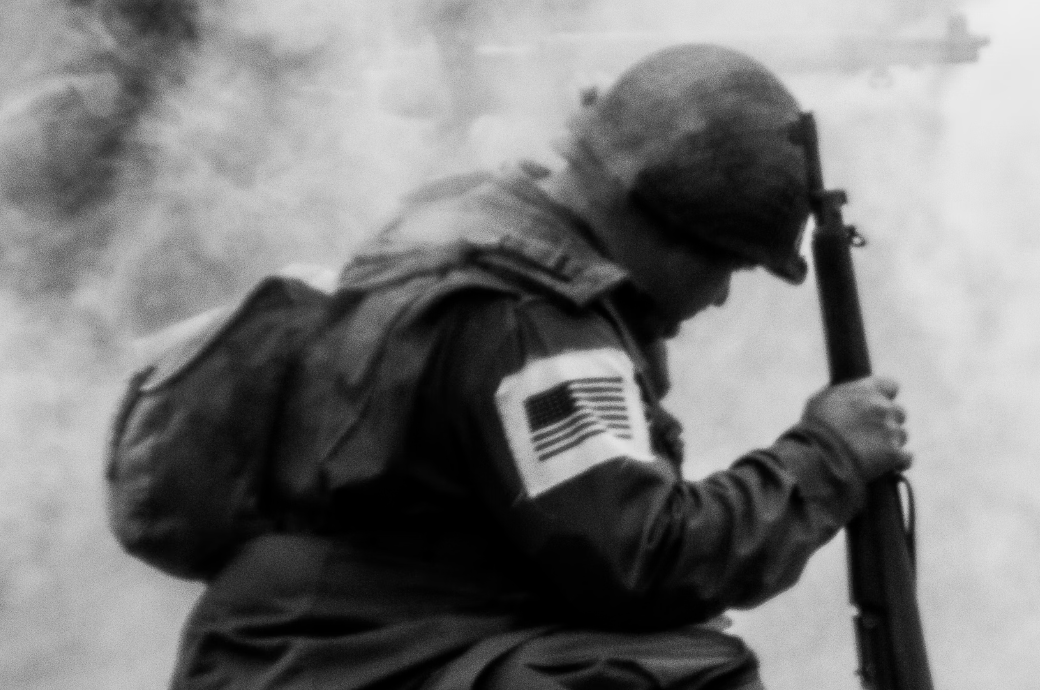
How would you respond to a threat? We want to think we’re ready and prepared, but it’s another thing when you are confronted by an enemy in the flesh. A friend of mine, wearing an expensive coat I gave him in post-Communist Poland, simply peed his pants when a gun was pointed at him by a robber. He couldn’t do anything else. Soldiers, even after training, can also discover the same futile reaction when bullets start flying past their heads. Here’s how one soldier in Iraq described his first battle: “I lay there, hugging the floor, my pants still soaked in piss. I was waiting to die. I was nineteen years old and had been out of high school for only a little over a year. I couldn’t help but wonder what had caused me to make the decision that had brought me to almost certain death in the city of mosques” (Alexander Saxby, Fallujah Memoirs: A Grunt’s Eye View of the Second Battle of Fallujah, 19).
We might chuckle at that reaction and say, “that wouldn’t be me,” but how should we respond to that kind of threat?
We must love our enemies while also preparing to kill them when necessary. I remember taking my wife to a shooting range, and she stood holding the pistol, breaking down in tears, unable to fire. “I just don’t want to do it,” she told me.
You don’t have to,” I responded, “but you are the one who wanted to come here. Remember why? You said you wanted to be able to protect your children if I wasn’t there. So, think about that. Think about shooting to protect your children.” She pulled the trigger.
It’s psychologically difficult to prepare to kill another human being. And it should be. It’s something you should never have to do. It’s so difficult that Lt. Col. Dave Grossman related in his book On Killing that “the vast majority of combatants throughout history, at the moment of truth, when they could and should kill the enemy, have found themselves to be unable to kill” (14).
Should they kill? That’s harder to answer than you might expect.
Imagine a French soldier in the trenches during World War I. The Germans are a few hundred yards away. They are your neighbors, so to speak, and many of them are fellow Catholics. There’s no good reason for this war. It should end — immediately. Nonetheless, you don’t have the option of giving up and going home. You might even be shot by your own commanders if you try. But if all the soldiers simply left, the Germans would occupy Paris . . . again. Compare that to thirty years later. The Germans are back. This time, you know their evil intent spurred on by a brutal, atheist dictator with no qualms about killing large groups of civilians. Your Jewish neighbors are gone. Your own family might be next. You’re part of the resistance hiding in the woods, and a convoy of German jeeps drives down the country road. You have an officer in your sights. Would you shoot?
As Christians, some suggest we should resist any violence, becoming pacifists. Jesus did teach us, “Do not resist one who is evil. But if anyone strikes you on the right cheek, turn to him the other also; and if any one would sue you and take your coat, let him have your cloak as well; and if any one forces you to go one mile, go with him two miles” (Matthew 5:39-41). Jesus did not resist those who sought to kill him but overcame their violence through love, knowing that it would triumph in the end. It is not wrong for Christians to follow Jesus’s example, living for the justice offered by the Father in the next life. Think of Bl. Franz Jägerstätter, the Austrian farmer, who was not a pacificist, who refused to take an oath to fight for the Nazis. He put his life and his family into the Father’s hands and accepted death for the Kingdom.
Does that mean that no one can serve as a soldier or offer self-defense? We could contrast our Lord’s saying on the Sermon on the Mount with the fact that centurions are universally praised in the New Testament. Jesus commends the faith of the centurion whose son he heals; the centurion acknowledges Jesus’s divine sonship at the foot of the Cross; and it is that centurion, Cornelius, a righteous man, who becomes the first Gentile convert. When soldiers ask John the Baptist how they should respond to his preaching, he does not tell them to abandon post. Rather, he commands, “Rob no one by violence or by false accusation, and be content with your wages” (Luke 3:14).

Ancient Christian soldiers could serve meritoriously in the Roman Empire so long as they followed the counsel of the St. John the Baptist and refrained from pagan oaths. Augustine even urged one commander not to abandon his defense of the frontier in favor of the monastic life. It was this same Doctor of the Church who taught just warfare: waged in self-defense, for a good cause, and without committing injustices. In Christian charity, the soldier can become a defender of society, self-sacrificially promoting order and peace. This became the ideal of the knight serving Christendom through arms by protecting the innocent and defending the Church.
The self-defense of a father for his family follows the same principles. You can and should defend your family, but only when absolutely necessary, without excessive force, and while avoiding hatred for the perpetrator. There may be times when we do not resist evil. We do not pick fights and chase after every cause. Think also of a missionary who willingly enters hostile territory without resistance, prepared to lay his life down for God by witnessing to his peace. A father, however, should never refuse his duty to protect his own, and by placing himself in harm’s way for his family, he manifests Christian charity.
Today, however, we often face an opposite problem to trigger hesitation. Isolated, spiritually distraught, and overly focused on pleasure, we don’t love our neighbors, let alone our enemies. In fact, we take human life lightly, objectifying it in our godless consumerist society. Grossman points out that we no longer carry the same hesitation to kill, citing Congressional testimony: “Well over 1,000 studies point overwhelmingly to a causal connection between media violence and aggressive behavior in some children. The conclusion of the public health community, based on over 30 years of research, is that viewing entertainment violence can lead to increases in aggressive attitudes, values and behavior, particularly in children. Its effects are measurable and long-lasting. Moreover, prolonged viewing of media violence can lead to emotional desensitization toward violence in real life” (17). Immersion into a violent virtual reality has broken down trust and charity, drawing forth hidden aggression and inclining many toward senseless violence.
Violence may be necessary as a response to this kind of aggression, and we must be prepared and ready to use it without falling into desensitization of its effects. We have to love even those who seek to kill us, remembering that they are our fellow human beings and in need of help. Easier said than done. Even if you shoot to kill, when an attacker becomes disarmed, you must offer your assistance and, afterward, your prayers. “Love your enemies and pray for those who persecute you” (Matthew 5:44). Jesus said that this is how you will know you are a son of the heavenly Father, acting as he did on the Cross.
As Christian men, we should embrace the principles of chivalry, using our strength to care for and defend others. We should prepare for emergencies and be ready to respond. But, like a Christian knight, we must perform all our actions for the honor and glory of our King, Jesus Christ. We must refuse to fight and kill for an unjust cause. We must avoid demonizing our enemies and seeking revenge for its own sake. We must do what we can to help those who seek our harm when the need arises.
This is how a Christian man conducts himself. It’s a difficult line to walk, but we must be ready to give and sacrifice ourselves for our family and country against enemies, though only out of love. In the face of senseless violence, we must be willing to face danger and lay our lives down for those we love.
Reprinted by partnership with Sword and Spade.
COMMENTS
Reader Interactions