
Share:
A blog for Catholic men that seeks to encourage virtue, the pursuit of holiness and the art of true masculinity.
What Marriage Makes You
July 27, 2026
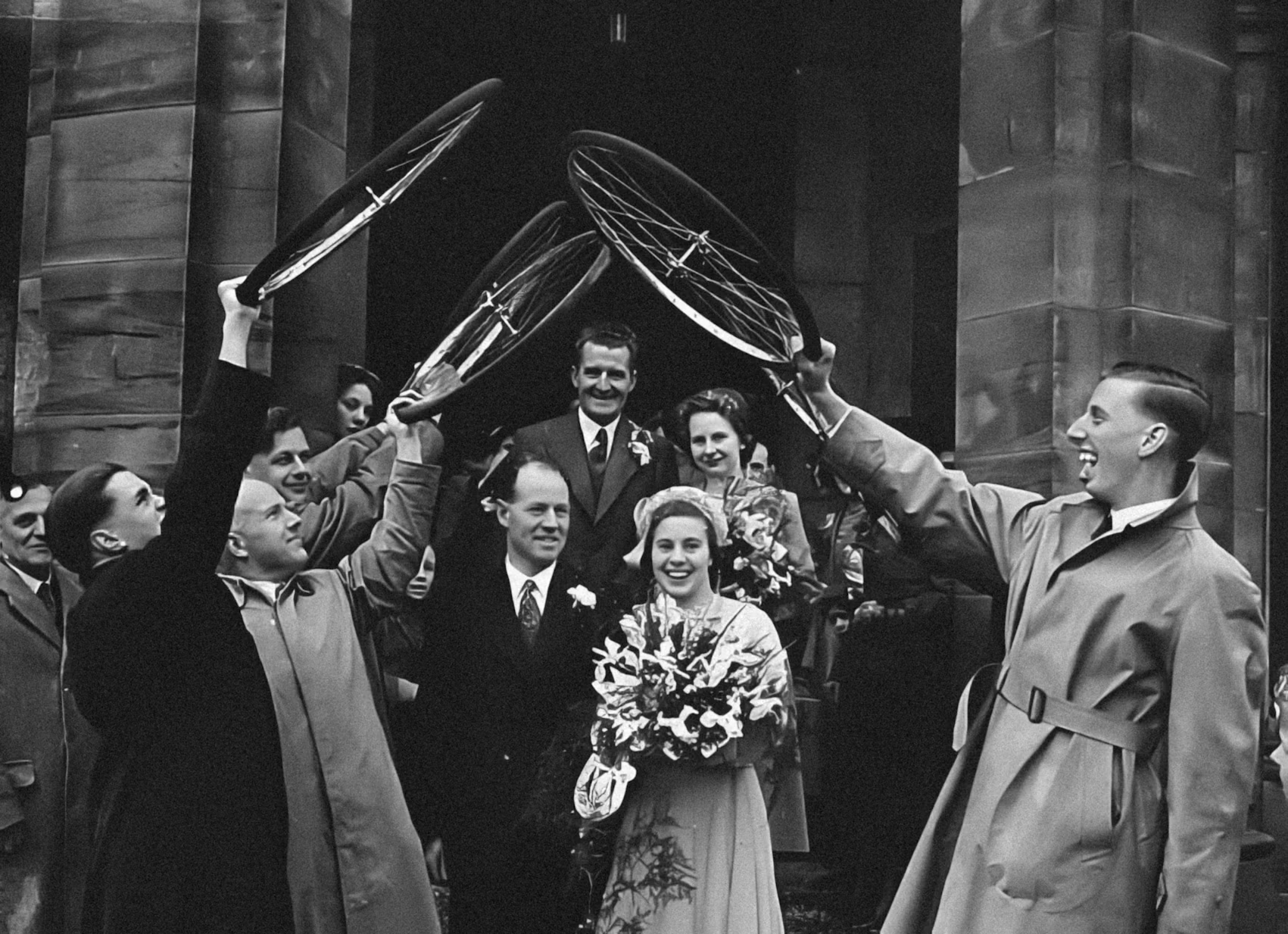
I was engaged to be married when I was 22, which I understood to be the achievement of manhood. The better part of my teenage years were spent preparing for that moment. This was it, I told myself, I was finally going to be a man. I was ready.
I wasn’t ready. I wasn’t ready for marriage, and I didn’t understand what it took to be a husband. I didn’t see this reality then, but I know that our Lord did. He gave me the gift of humility, because the next thing I knew the engagement was broken, and the relationship ended. I was left with many questions, doubts, and an abundance of advice. But I was certain of one thing: I needed to mature.
Not Enough
I was born in 1999 in Birmingham, AL the oldest of ten children. Looking back, I realize that I had a beautiful and stable childhood. I grew up in an emerging community of home-schooling families who wanted to raise their kids in a vibrant Catholic life. I was not aware of how counter cultural this was until high school, when it became clear to me that the experience I had as a kid was not the norm. To have two parents who loved each other dearly, who were dedicated to the daily work of living out their vocation, this was not the typical situation in America. As I understood the gift my parents had given me, I had a keen realization that I wanted my life to model what I experienced growing up. I wanted to be like my parents: grow up, get married, and start a family.
I became intensely focused on this desire toward the end of high school and into college. I believed that if I could check all of the right boxes I would end up with a happy marriage. So I set out to do just that. I worked really hard in school, graduated college, got a full-time job in the family business, bought a house, and got engaged to the young lady I had been dating. Everything looked just the way I had planned it. I had passed the test, and I was going to arrive. It was not as hard as everyone had said after all.
But I was wrong. I didn’t know how to receive God’s love, and I didn’t know how to give it. I had set before myself an image, a goal, and an achievement. This kept me from seeing the reality of what was about to take place in my life if my engagement had come to fruition. When my relationship ended, it was the first time in my life that I felt truly empty. The future seemed so uncertain, and I was embarrassed because I felt I had disappointed many people whom I loved.
At this point I was tired of telling God how I was going to do things and was finally ready to be taught, but I had no practice at receiving love and letting God lead me. Although I was committed to this internally, it was going to take starting over and a greater maturity in love to make my growth explicit in my life. This would only happen when I met the woman who would become my wife.
New Lessons
I remember walking out of church and seeing a beautiful young lady with her friends. She was new to the parish, and although I was hesitant to approach her (or any woman), I knew it was time “to get back on the horse.” I introduced myself and had a short conversation. A month later I asked her out for the first time, and a year and a half later we were married. We are currently eight months into marriage and expecting our first child who will be here in February. It has been a whirlwind and an influx of grace that I have not experienced at any other point of my life.
Marriage has not been what I had thought it would be. It is better than I ever imagined. But it has already forced me to change the way I think about masculinity and fatherhood. I can already see how there are purifications that could only have happened in my vocation, not while I was preparing for it.
I am hesitant to suggest that I have any wisdom to share in such a short time, but there are three important lessons that the “former me” needed to learn.
Lesson 1: Emotional Extremes are Bad
Marriage is filled with emotions, but I had not learned how to understand them and their purpose. Early in my life I did not deal with my emotions in an integrated way. I had a bit of a cliché vision of emotions from a stoic perspective, complete with “real men don’t cry” and “just tough it out.” There’s truth in grit, but I was unhealthy in my understanding. Emotions exist for a reason. It seems we either suppress them or let them loose without restraint, and I have been guilty of both.
Before marriage I suppressed any emotion in the realm of pain or hurt. I simply “did things” to make the pain better. This never worked, meaning it didn’t make me better. So, while my wife and I were dating I tried the other approach: I let them loose to her. I expressed every un-processed emotion I felt in difficult situations. She was there for me and listened, and thankfully she saw enough in me to bear with me.
But there came a point where she was done being my coping mechanism. She was tired of it, and said as much. She challenged me to something more productive than emoting everything. I had gone from a stoic to a whiner. It caused her so much stress to take on what I was feeling because I didn’t deal with it in a masculine way. I learned that I had to feel the emotion interiorly, process it in my intellect, and then choose the right path. I could not use her to process it for me. I needed my emotions to give me directions, but they actually were in the drivers seat. And, my wife needed to be my spouse, not just a recipient of all my crap. This wasn’t just a matter of balance, but of integrating the intellect and emotion that God had given me. Now I am better able to express not only the emotion but also my thoughts and conclusions. My emotions are no longer suppressed, but I also don’t let them loose without the will and intellect to guide. As a result, true vulnerability has become an integral part of our marriage. Now I can be as we all should, a man with his spouse, so that the two can unite more fully as one.

Lesson 2: Baggage Is Real but It Isn’t Terminal
Many marriages deal with the wounds of families and past relationships. My wife and I both brought baggage to the marriage, but I had the naïve idea that my marriage would be perfect and that I would not have to suffer from these past wounds nor suffer those of another. This just wasn’t the case.
Many people talk about this, but I had ignored this in my young adult life or at least thought I could avoid it. But denying my own wounds and past just made me focus solely on hers. I didn’t know what to do, thinking of her baggage made me feel insecure. I tried and tried to find a solution but one did not exist.
There were multiple steps in the process of healing, but the most significant occurred a month into our marriage. I expressed some of the same insecurities about our relationship because of our colliding histories, to which she responded, “why don’t you just protect me, why don’t you just protect us?” It hit me like a brick wall.
Yes, our lives had not been perfect, yes we had both made mistakes, but I was the husband, this was my family. Thinking about past mistakes and wounds in the context of protection gave me a way forward in knowing what to do as these things arose. I would protect her from the past, present, and future wounds, and I would protect her by prayer and forgiveness, not judgment and comparison. We had taken each other in marriage, but I was refusing to see the gravity of this union. From then on every time I felt insecure I recognized that she had given me her heart. She needed me to protect it, not constantly bring her back to the more difficult parts of her life, while neglecting mine. I had to assume my role. I didn’t always feel it, but I stopped vocalizing my insecurities, I stopped bringing up our wounds, and I offered them up to our Lord. The insecurities slowly decreased and the fears slowly subsided.
Lesson 3: Preconceptions Can Be Deceptions
New spouses unavoidably bring expectations to a marriage, and these might not match up. I was immediately more content in my marriage when I allowed my preconceived notions to die, so that I could be present in cultivating my household instead of forcing it into a mold. Part of the problem with my adolescent way of viewing marriage and family is that, in checking boxes to arrive at a destination, I subconsciously created a narrative of what that destination would look like. I had unrealistic expectations of marriage, mostly because I thought I could just duplicate what I had seen in my own and other families and not do the work of building and growing up together.
My expectations weren’t complicated, but they were immature. I wanted our prayer routine, weekly order, and schedule to be perfect, natural, and easy. I was hoping we would conceive as soon as we got married. Although we continue to strive for these goods, none of these realities were instantaneous. I was blind to the fact that we were two separate people who had lived apart for our entire lives. I was wrong to assume that I could simply lead us into an order of family life without struggling for it.
One of the biggest challenges to my preconceptions was our inability to conceive right away. This forced a need for patience I had not anticipated in the least. But, when we did conceive after some months, my reaction was even stranger to me. When, during the first trimester, my wife began suffering with the normal effects of pregnancy, I became selfish and frustrated. My newly established order changed as the child we had prayed so hard disrupted it. Our routines, shared duties, and schedule were upended. This was not what I thought it was going to be. I was having to seriously lead our home and step up to the plate.
The first week was fine. I helped where she needed me to fill in. But extra store runs, canceling plans, combined with my wife feeling sick was more than I was prepared to bear. When pregnant, she was not the same when I would get home from work (and rightfully so) and I didn’t know how to love her in a difficult period of feeling ill.
My irritation got so bad I wondered if I had even wanted to conceive in the first place. Did I really want to be a father? I felt like I wanted my wife back. It came to a head at Fraternus Ranch. I remember a conversation with a fellow captain where I was venting about how hard it all was. He called me out. Compassionately but sternly, he told me to grow up. Love her, sacrifice, and buckle down, “it isn’t your turn to be served.” He said that sometimes it is as simple as making her break- fast, so “go home and make it for her.” It was exactly what I needed to hear. I came home and began doing what he said. I started letting go of my selfishness and accepting the reality of fatherhood by doing stuff that needed doing. She continued to feel bad but I started to truly sacrifice. I began to love her and make the best of the stage we were in. At this writing we are halfway to the baby’s arrival, and I know this is forming me to be a father like nothing else could.
I believed marriage was something I could arrange. I have never been so happy to be wrong. I am serving my wife and our Lord in the proper way and I am receiving my vocation. It isn’t my invention; it’s a gift to me.
Reprinted by partnership with Sword and Spade.
COMMENTS
Reader Interactions